
What Does Mānuka Honey MGO Mean?
If you've been shopping for Mānuka honey, you've probably noticed that the label features the letters MGO and a number followed by a plus sign, like MGO 83+ or MGO 263+, and wondered what it indicates. It's one of the most common questions people ask when considering Mānuka honey, and understanding it helps you select the honey that best suits your requirements.
Here's a clear, practical breakdown of the Mānuka honey MGO meaning, how the MGO rating system works, and how it compares with the other grading system you'll often see alongside it: UMF.
Mānuka Honey MGO Meaning: The Short Answer
MGO stands for methylglyoxal. It's a natural compound that forms in the nectar of the Mānuka flower, native to New Zealand, and it's the primary source of Mānuka honey's distinctive antibacterial activity. Regular honey has much lower levels of methylglyoxal. Mānuka honey can contain significant amounts of MGO, and that's what sets it apart from the standard honey you'll find on a grocery shelf, or online.
The MGO number on a jar tells you the concentration of methylglyoxal in milligrams per kilogram (mg/kg) of honey. When you see MGO 83+, that means the honey contains at least 83 mg of methylglyoxal per kilogram. The plus sign confirms that number as a guaranteed minimum level of MGO, not an average.

How the Mānuka Honey MGO Rating System Works
The Mānuka honey MGO rating is used to give honey consumers a simple, numeric way to compare the potency of different jars. Ratings typically range from around MGO 30+ on the lower end up to MGO 900+ or higher for the most concentrated honey available.
As a general guide:
- Lower MGO (30+ to 100+). A concentration range often used for general wellness or as a daily addition to tea and food. Some multifloral blends can be found at the lower end of this range.
- Mid-range MGO (100+ to 400+). A stronger antibacterial profile, popular for immune support and everyday wellness regimen.
- High MGO (400+ to 900+ and above). The most potent and typically most expensive honey, often selected for more specific therapeutic use.
The higher the MGO number, the higher the concentration of methylglyoxal, and generally the stronger the antibacterial potency. This makes MGO one of the more direct, easy-to-understand ways to gauge the strength of a jar of Mānuka honey.
It's worth noting that MGO honey can legally be packed anywhere in the world, not only in New Zealand, so the MGO number alone doesn't confirm where the honey has been collected, bottled, or packaged.
Where the MGO Rating Came From
The MGO rating grew out of academic research into what actually makes Mānuka honey perform differently from other honey.
Professor Thomas Henle, a German food chemist, is the researcher most associated with identifying methylglyoxal as the compound behind Mānuka honey's antibacterial strength. His team at the Technical University of Dresden published this work in 2006, and the study showed that MGO was the dominant antibacterial constituent in New Zealand Mānuka honey.
Before this research, Mānuka honey was generally sold under a broad "special honey" claim, without much measurable proof behind it. Henle's findings helped shift that. And instead of a vague claim about unique properties, the honey industry gained a specific compound that could be identified, measured, and used to grade products in a consistent way.
MGO testing is a reliable and quantitative way to grade Mānuka honey, since it can be measured in laboratories rather than relying on subjective or anecdotal assessments. That lab-based measurability is what turned MGO into the rating system used on jars today.
MGO vs. UMF: What's the Difference?
Once you start comparing products, you'll likely notice another numerical grading alongside MGO: UMF, which stands for Unique Mānuka Factor. The two aren't competing numbers for the same thing. They measure different levels of quality assurance.
MGO measures one specific compound. It tells you how much methylglyoxal is in the honey and, by extension, gives a direct read on antibacterial potency.
UMF measures four separate markers, verified through independent laboratory testing:
- MGO (methylglyoxal). Identifies potency and antibacterial properties.
- Leptosperin. A marker found specifically in genuine Mānuka honey and used as an authenticity indicator.
- DHA (dihydroxyacetone). An indicator of shelf life potential.
- HMF (hydroxymethylfurfural). For freshness and storage quality.
Because UMF checks authenticity and freshness in addition to potency, it's generally considered a more complete quality assurance system. UMF ratings usually run from about 5+ up to 20+ or higher, and are commonly interpreted this way:
- UMF 5+. Suited to everyday wellness.
- UMF 10+. For daily immunity support.
- UMF 15+. A more potent, concentrated dose.
Why Experts Say The MGO Rating Alone Isn't Enough
Relying on MGO by itself has real limitations worth knowing before you buy.
MGO is only part of the picture. It measures one compound in Mānuka honey and reflects potency, but it does not on its own confirm authenticity, freshness, shelf life, or origin.
MGO levels can shift over time as DHA converts into MGO after harvest, so a single reading is only a snapshot. And by itself, MGO testing does not prove the honey is genuine Mānuka honey or that it was sourced from New Zealand, and it does not provide the same multi-factor assurance as UMF certification.
This is why many quality-focused New Zealand honey brands carry UMF certification in addition to an MGO number. It adds a higher level of independent, science-backed verification that MGO testing alone doesn't provide.
Which Mānuka Honey Rating Should You Look For?
The practical takeaway comes down to two points.
MGO tells you how strong the honey is. It's a useful, straightforward number for comparing potency between jars.
UMF tells you the honey is authentic, fresh, and what it claims to be, because it verifies MGO alongside leptosperin, DHA, and HMF through independent lab testing.
If you're simply comparing potency between two jars of Mānuka honey, the MGO rating is a fast and reliable reference point. But if authenticity, freshness, and full quality assurance matter to you, and they should given how often Mānuka honey is counterfeited or diluted, looking for UMF certification alongside the MGO number gives you far more confidence in what you're buying.

MGO And UMF: The Key Takeaway
MGO in Mānuka honey stands for methylglyoxal, the natural compound responsible for the honey's antibacterial power, and the Mānuka honey MGO rating on the label tells you exactly how much of it is present per kilogram. It's a genuinely useful number, but it's not the whole story. For full peace of mind about authenticity, freshness, and overall quality, having MGO as well as UMF certification gives you the most complete picture before you commit to a jar.
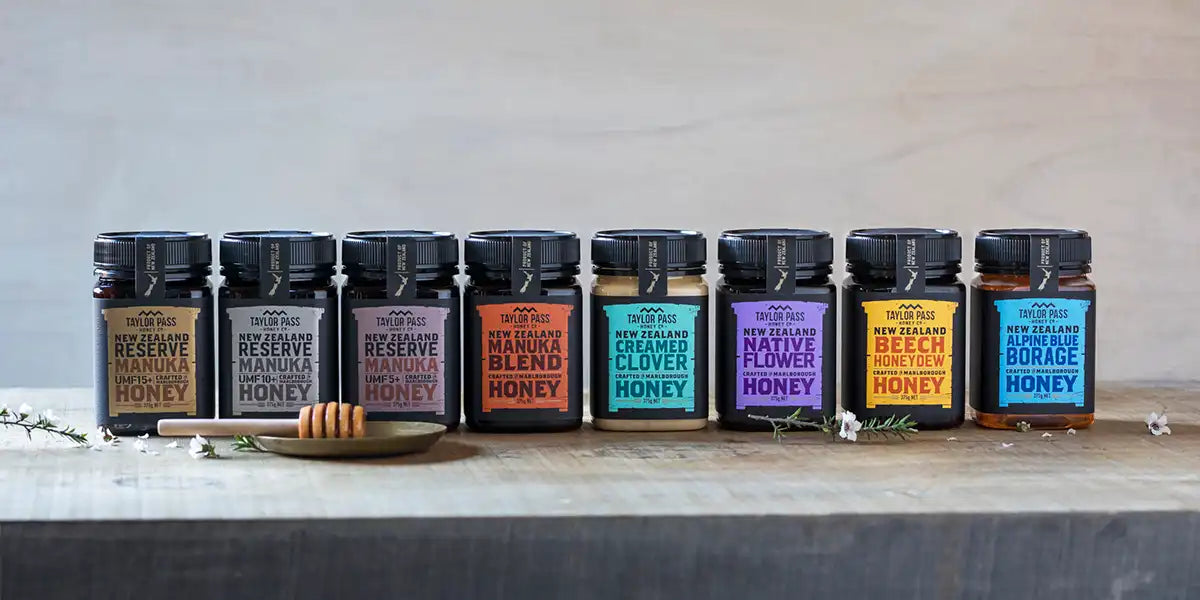
At Taylor Pass Honey, our UMF-certified and MGO-rated Mānuka Honey range is independently tested and guaranteed to have a UMF of 5+ or higher. You can find the MGO Mānuka honey that fits your needs at www.taylorpasshoney.com or discover your local store here.